
Basement Waterproofing
Philadelphia, PA
Keeping Basements Dry
Contact Us
Keep Your Basement Dry and Your Foundation Protected
A little water in your basement can be the first sign of a much larger moisture or drainage problem.
Water may enter through a foundation crack during a storm, seep through an older masonry wall, appear where the basement wall meets the floor, or slowly create damp conditions that never seem to completely disappear.
The important question is not simply how do we stop the visible water? It is why is the water getting into the basement in the first place?
Philadelphia Foundation Repair & Waterproofing provides professional basement waterproofing in Philadelphia, PA for leaking basements, wet walls and floors, groundwater intrusion, foundation cracks, drainage problems and recurring moisture.
Our approach begins with identifying the source of the water. From there, we determine whether your property needs targeted leak repair, interior drainage, a sump pump, wall or floor waterproofing, exterior foundation waterproofing, or a combination of solutions.
We work with the conditions commonly found throughout Philadelphia, including older masonry basements, row homes, concrete block foundations, stone foundation walls and properties where exterior access can be limited.
Call (215) 585-2996 for a free basement waterproofing estimate
What Is Basement Waterproofing?
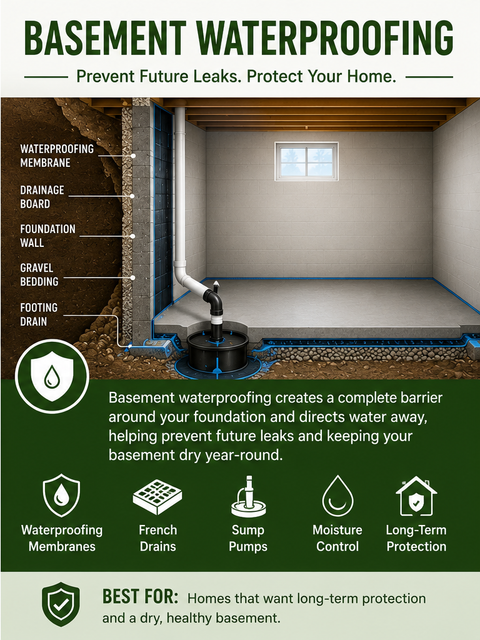
Basement waterproofing is the process of controlling water and moisture around or inside a below grade foundation to help keep the basement dry.
That sounds straightforward, but basement water can come from several different places.
It may originate from:
- Groundwater around the foundation
- Saturated soil after heavy rain
- Foundation cracks
- Porous masonry
- Mortar joints
- Basement wall seepage
- Water beneath the basement floor
- The wall and floor joint
- Poor exterior drainage
- Foundation penetrations
- Basement windows
- Existing drainage failures
That is why there is no single product that constitutes a complete basement waterproofing solution.
A properly designed system should address the source, pathway, collection and removal of water.
For one property, that may mean repairing an isolated leaking crack.
For another, it could require an interior perimeter drainage system connected to a sump pump. Another basement may need exterior foundation waterproofing. And some properties have several contributing problems that need to be addressed together.
Why Philadelphia Basements Leak
Philadelphia has a large inventory of older homes, and basement construction can vary considerably from one property to another.
We encounter foundations constructed from:
- Stone
- Brick
- Concrete block
- Poured concrete
- Mixed masonry
- Previously repaired or altered materials
Older foundations can also have decades of patches, coatings, repointing, structural modifications and previous attempts at waterproofing. Then there is the property itself. Row homes can have neighboring structures directly beside the foundation. Narrow alleys, sidewalks, porches, additions and utilities can make exterior access difficult.
When heavy rain saturates the ground, water can accumulate around and beneath the foundation. If the basement has a vulnerable crack, joint, porous masonry section or drainage deficiency, that moisture can find a pathway inside.
Basement Leak Repair
An active basement leak gives us an important clue, but the location where you see water is not always where the problem begins. Our basement leak repair Philadelphia service focuses on tracing water intrusion back to its source and correcting the condition responsible for it.
Leaks may be associated with foundation cracks, joints, wall penetrations, basement windows, drainage problems, porous masonry, or water pressure around the foundation.
Depending on what we find, repairs may include crack sealing, drainage corrections, interior waterproofing, exterior waterproofing, French drains, sump pump systems, foundation sealing, or other targeted repairs.
If you already have an active leak, visit our dedicated Basement Leak Repair Philadelphia page for a more detailed explanation of how we diagnose and repair basement water intrusion.
Wet Basement Repair
A basement does not need to be completely flooded to have a water problem.
Damp walls, small puddles, water stains, recurring humidity, musty odors, and moisture around the perimeter can all indicate that water is reaching areas where it should not.
Our wet basement repair process begins by determining whether the moisture is associated with groundwater, surface drainage, cracks, wall seepage, floor seepage, plumbing, or another source.
The solution should address the cause instead of simply hiding the evidence.
Interior Basement Waterproofing
Interior basement waterproofing is often used to collect and manage water that reaches the basement or foundation.
Depending on the property, an interior system may incorporate perimeter drainage, French drains, sump pumps, wall drainage materials, crack repairs, vapor management, or other components.
The purpose is not simply to make the basement look dry. A properly planned system gives unwanted water a controlled path so it can be collected and removed instead of spreading across the basement.
Interior waterproofing near me can be particularly useful when exterior excavation is difficult or when groundwater needs to be managed beneath or around the basement floor.
"Best basement waterproofing in the Philadelphia metro area hands down! Out of everyone I called you answered the phone, didn't make me wait weeks for a free quote and actually gave me a very great price. My basement hear in Swarthmore, PA has had a leak for years now, and it's finally sealed up. I'm glad we chose Philadelphia Foundation Repair & Waterproofing."
~ Adam Kennedy
Exterior Basement Waterproofing
Exterior waterproofing approaches the problem from the opposite direction by addressing water before it reaches the interior basement.
Depending on access and existing conditions, exterior work may involve excavation around affected foundation areas, repairing cracks or defects, applying appropriate waterproofing materials, improving drainage, and correcting conditions that allow water to remain against the foundation.
Interior and exterior basement foundation waterproofing are not interchangeable solutions in every situation. Our job is to determine which approach makes sense for the actual source of the problem.
Basement Wall Waterproofing & Repair
Water stains, damp masonry, leaking cracks, and deteriorating mortar can all indicate that moisture is finding its way through your basement walls. Our basement wall waterproofing and repair services in Philadelphia address both the visible damage and the source of the water intrusion. Depending on the condition of the wall, repairs may include removing loose or deteriorated material, opening and preparing damaged cracks or joints, sealing vulnerable areas, repairing masonry, and integrating the wall with an interior or exterior waterproofing system. The goal is not to simply cover a wet wall, but to identify how water is entering, make the necessary repairs, and provide a long term solution for a stronger, drier basement.
Basement Wall Waterproofing
Damp basement walls can result from several different conditions, which is why we do not assume that applying another coating will solve every problem.
Water may reach a basement wall through cracks, masonry joints, penetrations, exterior drainage problems, or pressure from saturated soil.
Basement wall waterproofing may involve sealing specific entry points, repairing cracks, managing water behind the wall, exterior waterproofing, drainage improvements, or combining several methods. The correct solution depends on how the water is reaching the wall.
Basement Floor Waterproofing
Water appearing on a basement floor does not always mean the floor itself has failed.
Moisture may enter around the perimeter, through cracks or joints, from beneath the slab, or from another source before spreading across the floor.
Our inspection is intended to identify that pathway before recommending basement floor waterproofing, drainage, or sump pump improvements.
Basement Waterproofing Services
Philadelphia, Pennsylvania
French Drain Installation
A French drain is one of the primary tools used to manage unwanted water around a basement or foundation. Rather than allowing groundwater to collect against walls or beneath the basement, the drainage system intercepts water and directs it toward an appropriate discharge point or sump system.
Basement French Drain Systems are commonly installed around the basement perimeter. Exterior drainage may be appropriate when surface water or groundwater needs to be managed before it reaches the foundation. Normally Only 1 unit is required. In larger spaces it may require multiple
Drain placement, slope, discharge, foundation construction, and the source of the water all matter. Simply installing a trench and pipe does not automatically correct every basement water problem. The drainage system has to be designed around how water behaves at the property.
Properties with uneven settling, especially those on sloped land, can experience more significant damage. However, we’ve seen and successfully addressed all types of foundation challenges throughout Pennsylvania and New Jersey. Our team is committed to repairing foundation leaks and preventing further damage, especially before the winter months arrive.
We understand the importance of a stable foundation year-round—whether it’s winter, spring, summer, or fall. As one of the leading basement waterproofing companies in Philadelphia, we’re here to ensure your property stays secure, dry, and properly supported, no matter the season.
“After seeing you repair our neighbor’s foundation and fix their basement issues, we decided to give yall a call. Philly Foundation Repair handled our home better than we expected. Ed came out pretty fast and gave us a thorough break down on exactly what was happening, why it was happening, and a few solutions to fix it. When the crew came they went straight to work and were very kind. We highly recommend Philly Foundation Repair to everyone.”
~ Lisa T, Parker - Bensalem, PA
Waterproofing Basement Walls and Floors - 5 Key Benefits
Many homeowners consider waterproofing their basements and attics for several reasons. One of the top reasons is to stop water damage from occurring. Waterproofing prevents expensive repairs including basement flooding, which can be detrimental to the home's structure. It also helps to create a healthier living environment for the family as it only requires 48-hours for mold to develop on a wet surface. If water gets in the home, the damage is much more extensive, with mold causing respiratory issues, allergies, and other health problems for occupants.
"They did a great job on my basement. I would 100% recommend you guys to others that I know. I've dealt with plenty of ppl before with this type of thing and this is the 1st time I got a reasonable price and great service. Thanks guys for an outstanding experience"
~ Christopher Launi
Sump Pump Installation and Replacement
A drainage system needs somewhere to send the water it collects. That's why we use a sump pump collect the water in a sump basin and pump the water away from the basement to an appropriate discharge location, preferably outside the property.
Sump pumps can play an important role in homes where groundwater routinely accumulates beneath or around the foundation. We evaluate the drainage system, expected water volume, pump condition, basin, discharge arrangement, and overall waterproofing setup before recommending installation or replacement. The most common is a pedestal sump pump. Using a submersible sump pump isn't necessary for a home.
For properties where losing the primary pump during a power outage would create a significant flooding risk, backup protection may also be worth considering. The goal is not simply to install a pump. The pump needs to function as part of the entire water management system.
"The Hard Knox team did such a great job! I called Ed on a Sunday asking for help and he was at my house in an hour with a quote, by Tuesday the basement was waterproofed and drying. The guys were meticulous, quiet while I was working and it looks beautiful. I would definitely recommend Philly Foundation Repair."
~ Danielle Fewings
Foundation Waterproofing
Basement waterproofing and foundation waterproofing are closely connected, but they are not always the same thing. Basement waterproofing focuses on keeping the below grade space dry and managing water intrusion.
Foundation waterproofing focuses more specifically on preventing or controlling water around foundation walls, joints, cracks, and other vulnerable areas. Depending on the problem, foundation waterproofing services may involve exterior membranes or coatings, crack repair, drainage improvements, interior water management, foundation sealing, or combinations of these methods.
Water should be managed as a system. Stopping one leak while allowing water to continue accumulating against the foundation can leave the underlying condition unresolved.
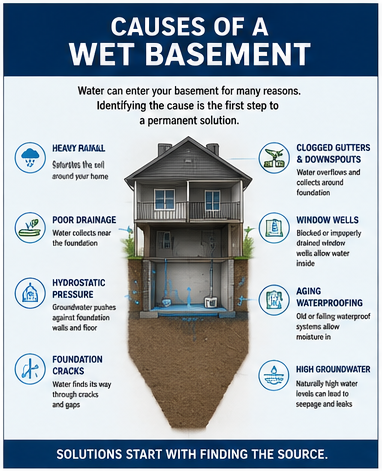
Why Is Water Getting Into My Philadelphia Basement?
There can be several causes, and sometimes more than one condition is present.
Heavy Rain and Saturated Ground
Periods of significant rain can saturate the soil around a home.
As more water accumulates around and beneath the foundation, it naturally looks for places to move. Existing cracks, joints, penetrations, porous masonry, and vulnerable areas around the basement can provide pathways.
Hydrostatic Pressure
Groundwater around a basement can create pressure against walls and beneath floors.
When that pressure becomes greater than what vulnerable joints, cracks, or materials can resist, water may enter through those areas.
This is one reason a basement may remain dry during ordinary weather but leak during extended or heavy rainfall.
Poor Exterior Drainage
Water should move away from the foundation. Improper grading, poorly managed roof runoff, clogged drainage, or other exterior conditions can increase the amount of water collecting near the home. Correcting exterior water management can therefore be an important part of some waterproofing projects.
Foundation and Basement Cracks
Cracks can create pathways for water. However, we also want to understand why the crack exists.
Some cracks are relatively stable. Others can be associated with movement, settlement, or structural conditions that require more than waterproofing.
Wall and Floor Joints
The point where the basement wall meets the floor is another common area where water becomes visible.
When groundwater builds around or beneath the foundation, water can migrate through vulnerable joints and enter around the basement perimeter.
Basement Waterproofing for Pennsylvania Homes
Philadelphia has a large variety of residential construction.
A waterproofing approach that works for one basement may not be appropriate for another.
Older masonry basements, row homes, concrete foundations, finished basements, unfinished utility basements, additions, and properties with limited exterior access can all present different challenges.
That is especially important with older masonry.
The condition of stone, block, brick, mortar, previous repairs, coatings, and drainage should be considered before choosing a repair method. We do not believe in assuming that every basement needs the same French drain, the same wall coating, or the same waterproofing package. The system should fit the property.
Signs You May Need Basement Waterproofing
Some water problems are obvious. Others develop gradually.
You should consider having the basement inspected if you notice:
- Recurring water after storms
- Wet spots along basement walls
- Water along the basement perimeter
- Damp concrete or masonry
- White mineral deposits on masonry
- Peeling or bubbling finishes
- Musty odors
- Persistent basement humidity
- Mold growth associated with moisture
- Water stains
- Foundation cracks that leak
- Rust or moisture damage around basement components
- A sump pump that runs frequently
- A sump pump that cannot keep up during storms
- Water entering around basement windows
- Previous basement flooding
Catching a water problem early gives you more time to understand the cause before additional areas are affected.
Our Basement Waterproofing Process
1. Inspect the Problem
We start with the areas where water or moisture has been observed. We look for visible cracks, stains, wall and floor seepage, drainage issues, damaged materials, and other clues that can help explain what is happening.
2. Determine Where the Water Is Coming From
The visible puddle is not necessarily the source. We evaluate the likely water pathway and whether the problem appears related to groundwater, surface drainage, foundation cracks, masonry, wall and floor joints, windows, penetrations, or another condition.
3. Determine Why It Is Happening
This is where waterproofing becomes more than simply sealing something. We want to understand why water is reaching that location so the repair addresses the underlying condition whenever practical.
4. Recommend the Appropriate Solution
Depending on our findings, recommendations may include:
- Basement leak repair
- Interior waterproofing
- Exterior waterproofing
- French drain installation
- Sump pump installation or replacement
- Foundation crack repair
- Basement wall waterproofing
- Drainage improvements
- Foundation waterproofing
- Moisture management
- Structural repair when necessary
5. Complete the Work
Once the scope is established, the selected repairs and waterproofing systems are installed according to the needs of the property.
6. Review the Completed System
After installation, we review the completed work and explain important operating or maintenance considerations associated with the system.
Mold Removal can be done by the homeowner or a professional service, it doesn't matter it can be done either way there are hidden dangers lurking in black mold removal that you need to be aware of. Even though black mold removal can be done effectively with the right knowledge, many people try their own method of removal and end up making the situation much worse than before. There is tons of information available on DIY black mold removal, however, that really is not a smart idea. Done incorrectly, removing black mold on your own can worsen the situation and put you and your family at serious risk, learning the hidden dangers of DIY black mold removal should be a requirement for protecting your family in the future.
It's important to be aware of the signs and symptoms of black mold in your home, as it can pose serious health risks. Below, are the key symptoms to help you identify potential mold issues early, so you can take the necessary steps to protect your property and your health.
Foundation Repair Philadelphia
Water and structural problems sometimes overlap. That is why Philadelphia Foundation Repair & Waterproofing also provides professional foundation repair Philadelphia services.
The important distinction is determining whether you have a water problem, a structural problem, or both.
Signs that may justify a foundation evaluation include:
- Foundation cracks
- Bowing basement walls
- Uneven or sloping floors
- Doors or windows that become difficult to operate
- Visible foundation movement
- Wall displacement
- Settlement
- Gaps developing around structural components
- Recurring cracks after previous repairs
"Excellent service, excellent quality of work. Night and day difference in my basement. Ed is a very honest and upfront guy, easy to work with, and responsive. Pricing was reasonable. Your crews showed up when they said they would and banged out all the work within a couple of days, with stellar results. I would highly recommend them to anyone!"
~ Vinny Gerbino
Foundation Crack Repair
Not every foundation crack means the structure is failing, but cracks should be evaluated in context. We consider location, direction, width, movement, water intrusion, and surrounding conditions before determining an appropriate foundation crack repair approach.
Foundation Underpinning
Foundation underpinning is used in situations where an existing foundation needs additional support or stabilization.
The appropriate method depends on the structure, foundation, existing conditions, and reason additional support is required.
Basement Underpinning
Basement underpinning may be used to strengthen an existing foundation and, in certain projects, accommodate changes to the basement. Because underpinning involves structural components of the building, proper evaluation and planning are critical.
Foundation Settlement Repair
Foundation settlement can produce cracks, uneven conditions, separation around doors or windows, and other visible changes.
A settlement repair should address the structural condition rather than simply patching the cosmetic evidence.
Bowing Basement Wall Repair
A basement wall that is bowing, leaning, or showing significant displacement should be treated differently from a wall with ordinary moisture staining.
We evaluate the condition to determine whether stabilization or structural repair should be considered in addition to water management.
Slab Lifting and Leveling
Sunken or uneven concrete does not always require complete replacement.
Depending on the slab and underlying conditions,
slab lifting and leveling may be an option for restoring the surface.
Crawl Space Moisture Encapsulation
Basements are not the only below grade or low clearance areas affected by moisture. A damp crawl space can expose framing and other building materials to prolonged humidity and moisture.
Where applicable, crawl space solutions may include drainage improvements, moisture barriers, encapsulation, sump systems, or other methods designed around the source of the moisture.
Our future Crawl Space Repair and Crawl Space Waterproofing resources will cover these systems in greater detail.
Why Choose Philadelphia Foundation Repair & Waterproofing?
01
We find the source
We want to understand how water is reaching the basement.
02
Explain the problem
Homeowners should understand what we found and why we are recommending a particular repair.
03
Use the right solution
A foundation crack does not automatically require a complete drainage system, and a serious groundwater problem should not be treated with a cosmetic patch.
04
Keep communication straightforward.
We break down the project to you step by step before work begins and it doesn't end when the job is done!